


Drats! Technological issues again! I’ll leave you with this audio re-recording of the homily.
Christ Lutheran Church in Aptos, CA
Click here for assigned Scripture readings
How’d you like that Genesis reading?! It’s a long one, right? A very, very long one. We just made it through the entire first chapter of the Bible, all the way from the formless void to the quiet of the seventh day.
You have to wonder: why do we still read these ancient stories?
It’s because creation stories are never just about how the dirt and the sky got here. They aren’t mere historical artifacts. Creation stories are maps of our inner landscape, mirrors of our psychology. The story we believe about how the world began is almost always the script we run to determine how we make our way through a Thursday afternoon. We live out of the origin stories we carry in our bones.
To understand just how radical this Genesis creation poem is, we have to look at the story it was written to defeat.
Thousands of years ago, the dominant global superpower was Babylon. They had a famous creation myth called the Enuma Elish. In it, the universe begins with a bloody civil war among the gods. The king of the gods slaughters the chaos monster, Tiamat, rips her body in half like a dried fish, and fashions the sky and earth out of her carcass.
Then, he creates human beings out of the blood of the defeated rebel god, purely to act as slave labor so the gods can take a nap.
It sounds bizarre, but if we examine ourselves honestly, we carry that Babylonian script inside us every single day. It’s wired deep into our survival-driven, tribal nature. We act as though the world is a violent arena where resources are scarce, and the only way to survive is to conquer a monster. Look no further than how our 250th will soon be celebrated by a human bloody cage match.
But this absurdity is no new thing. For at least forty years now—and probably more like forty thousand!—long before smartphones, our television screens and kitchen radios have run this exact script. Media outlets realized that keeping us afraid of a monster keeps us tuned in. We’ve been conditioned to watch a world divided into neat, hostile boxes, told that to figure out who we are, we must first know who we are against. Partisan politics became our identity; our media habits became our practicing religion.
The internet came along and put this on hyper-drive, turning a morning or nightly habit into a twenty-four-hour pocket-sized obsession. It’s a brutal, exhausting law: Prove your loyalty. Defend your tribe. Defeat your rival. Or perish. It’s killing us with division, leaving the body of Christ broken and lonely.
And it’s precisely into that exhausted, battle-weary world that the poetry of Genesis drops... like a piano in a Wile E. Coyote cartoon.
When the priestly poets wrote these words, they were sitting as captives in Babylon, hearing these violent myths every single day. This poem was their quiet, subversive response:
“No. That’s not how the world works. The world is not born from violence. It may have gotten there eventually, but the world... is born... loved.”
And God saw that His new creation was beautiful and good.
Look at what is not in this story. There’s no monster. No rival. God doesn’t have to defeat anyone to be God. God isn’t an engineer frantically inspecting factory output...
God is an artist stepping back to savor the canvas. God looks at the light, the rolling seas, the swarming fish, the green grass, and all the complexity and life and death that they contain... And God pauses, savors, and calls it beautiful before humans even show up to do a single day of work.
Divine goodness comes before human effort. God isn’t waiting for creation to earn God’s pleasure; God’s pleasure is creation’s very origin.
And then, God says this: “Now let Us conceive a new creation—humanity—made in Our image, fashioned according to Our likeness.”
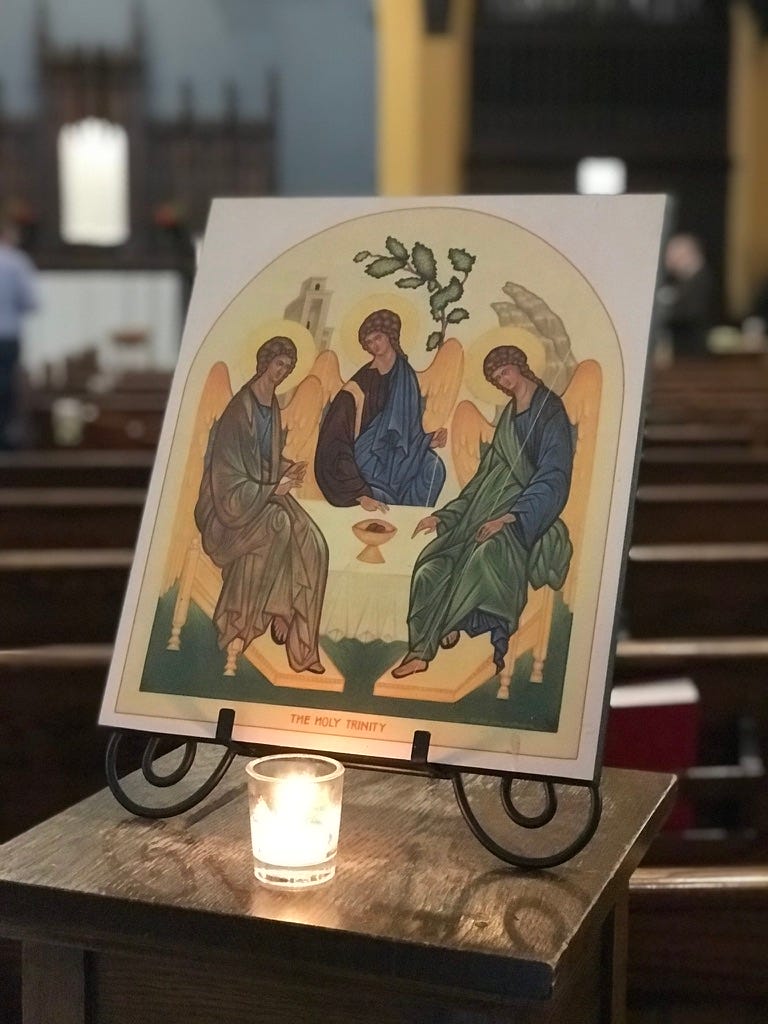
This isn’t the “us” of a political coalition forming against an outside threat. This is the “Us” of the Trinity—the very pattern of beingness—Father, Son, and Holy Spirit—an eternal circle dance of self-giving love, overflowing generosity, and pure relationship. The Triune God has no enemy. Beingness has no rival. The Trinity has no “other” to fight, because nothing exists outside of it.
It’s not up to you to make yourself good; you have been spoken good by a God who cannot stop delighting in you.
This is the scandalous gospel that blows our cultural identity games right out of the water. The good news of Jesus Christ is not a self-help program to make us adequate or pure. The church’s job is not to be the bouncer at the door of the kingdom, checking credentials and sorting the deserving from the undeserving.
The job of the church is to fling the doors wide open and announce that the party has already begun.
Look at the gospel story. The eleven disciples go up to the mountain in Galilee. And The Voice translation includes this wonderfully honest, comforting line: “When the disciples saw Jesus there, many of them fell down and worshiped... But a few hung back. They were not sure (and who can blame them?)”
These are the pillars of the church. The resurrected Jesus is standing right in front of them. And yet, they simultaneously worship and waver. They believe, and they don’t believe. They’re full of faith, and full of doubt.
And what does Jesus do? Does he demand an algorithm-approved statement of absolute certainty? Does he tell the wavering ones to leave the mountain until they get their acts together?
No. He walks right toward them. He commissions them in their complexity and nuance and doubt and faith. He plunges them into the name of the Triune God—Father, Son, and Holy Spirit—which is to say, He plunges them into grace all the way down.
Jesus has absolutely no trouble working with broken, wavering, complicated people (meaning you, me, and all our neighbors).
Your doubt doesn’t disqualify you. Your exhaustion doesn’t disqualify you. You are held within the life of God, and you always have been.
So what do we do with this? How do we live inside this relationally Trinitarian shape in a world that wants to tear us apart?
Ultimately, this is a God thing. We trust that God is working healing and wholeness in our individual souls and our collective life. But practically, we start by refusing to let the digital arena consume our physical, relational world.
Listen to Saint Paul’s final words to the Corinthians after serious trauma and conflict: “Finally, brothers and sisters, keep rejoicing and repair whatever is broken. Encourage each other, think as one, and live at peace... Greet each other with a holy kiss.”
That word Paul uses for “repair” is not abstract. It’s the tactile word the fishermen of old used for mending their torn fishing nets. It’s messy, hands-on work. You can’t mend a fishing net over the internet or via an AI chatbot. You have to sit on the dock, shoulder to shoulder, feel the coarse twine in your fingers, and untangle the knots together.
The Trinitarian life is community repair, embodied in how our actual physical bodies come together. It means looking at the person sitting across the aisle—the one who drives you crazy, votes differently, or watches the other news channel—and realizing that they, too, were spoken into existence by the sheer, unthreatened delight of God.
And the ultimate antidote to the arena is right here, at this altar. We don’t come forward as a political caucus or an ideological club. We come as a beloved collection of complex, nuanced people who worship and waver all at the same time.
We take real bread, and real wine. Physical things. And we receive the radical, unearned, unconditional grace of a God who refuses to play our little rivalry games. At this table, there are no insiders or outsiders. Only hungry people being fed by a God of infinite generosity. And made in the image of that generosity.
So leave the old stories at the door. Come to the table, taste and see that the Lord is good. Because that’s the true story. The story of us... God-breathed dirt creatures. Delighted in by a God who takes joy in all creation.